Maximizing Solar Efficiency with Energy Storage Systems

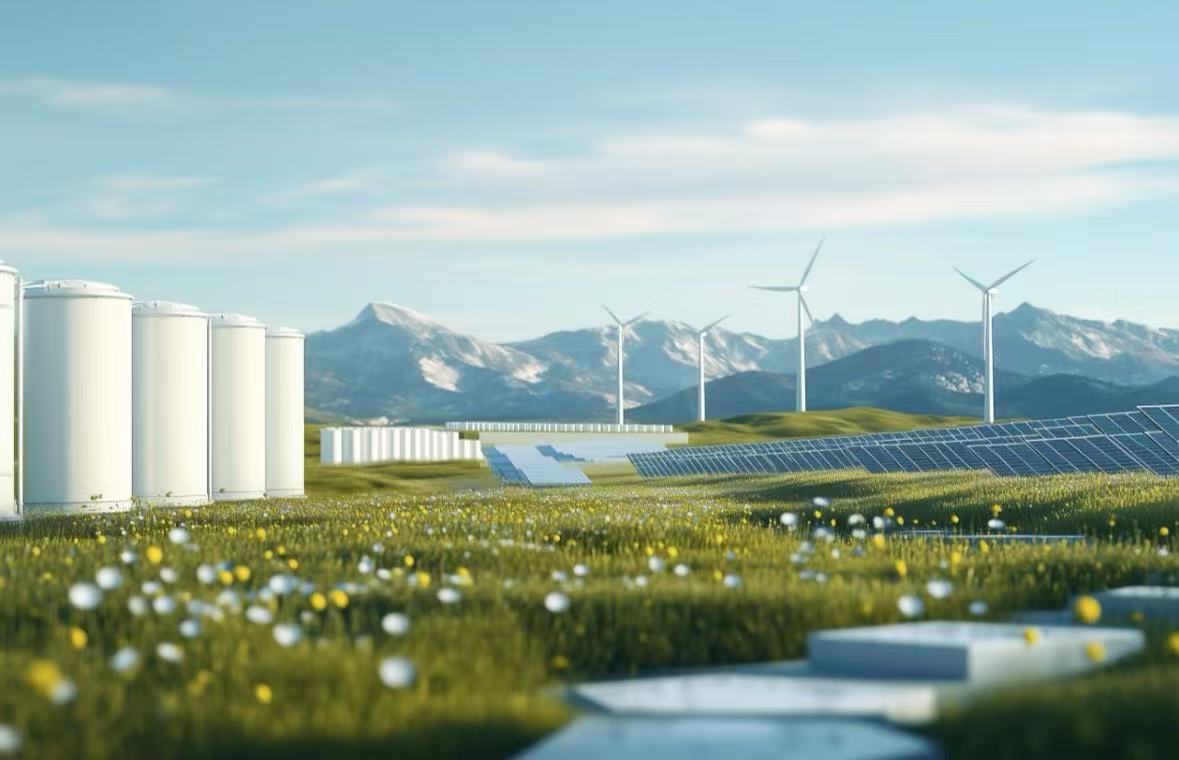
In today's world, the demand for sustainable energy solutions is at an all-time high. One of the most promising technologies in this field is the Energy Storage System, which plays a crucial role in optimizing the efficiency and reliability of renewable energy sources such as solar power systems with battery storage. These systems are not only environmentally friendly but also offer cost-effective solutions for both residential and commercial energy needs.


solar power systems with battery storage


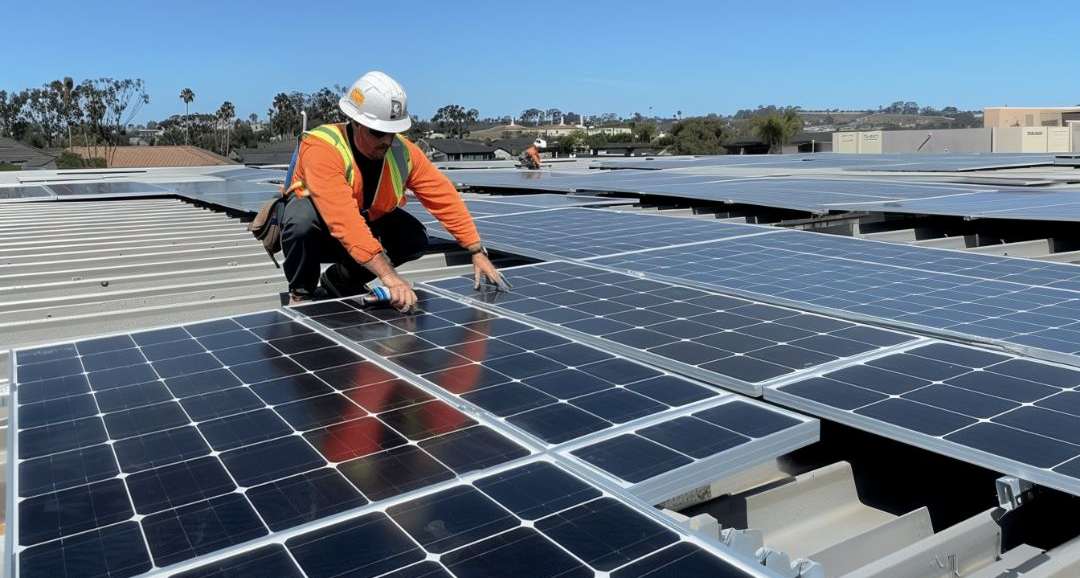
When it comes to solar power systems with battery storage, the benefits are manifold. By incorporating energy storage systems into solar panel installations, users can store excess energy generated during the day for use during peak demand periods or at night. This not only increases self-consumption but also reduces dependency on the grid, resulting in significant cost savings in the long run.

Speaking of cost, solar panels with battery storage have become increasingly affordable in recent years. The initial investment may seem daunting, but the long-term savings on electricity bills and potential incentives can make it a worthwhile financial decision. Understanding the solar battery storage system cost and exploring options like the Generac PWRcell can help individuals and businesses make informed choices based on their energy needs and budget.


solar panels with battery storage cost


The solar storage battery cost may vary depending on factors like capacity, brand, and additional features. However, the overall trend indicates a decrease in prices as technology advances and demand grows. Investing in a reliable energy storage system not only benefits the environment but also adds value to properties and promotes energy independence.


solar battery storage system cost


Enter GreenMore+ Energy Storage System—a comprehensive solution that combines cutting-edge technology with exceptional service. Not only does GreenMore offer top-of-the-line products like the Generac PWRcell at competitive prices, but it also provides unparalleled customer support and maintenance services. With GreenMore, you're not just investing in an energy storage system; you're gaining a trusted partner committed to your energy needs.

In conclusion, the future of sustainable energy lies in the seamless integration of solar power systems with battery storage. By understanding the solar panels with battery storage cost, solar battery storage system cost, and the benefits of solutions like the Generac PWRcell, individuals and businesses can make informed decisions that align with their sustainability goals and financial objectives. With GreenMore+ Energy Storage System, the possibilities for a greener, more efficient future are limitless.


Solar Roof Tiles Explained Stylish Design Meets Sustainable Power

Introduction

Homeowners today are looking for energy solutions that combine sustainability, efficiency, and aesthetic appeal. Traditional solar panels have long been the go-to option, but solar roof tiles are quickly emerging as a stylish alternative. At GreenMore, we believe that solar technology should not only power your home but also enhance its design.


What Are Solar Roof Tiles?

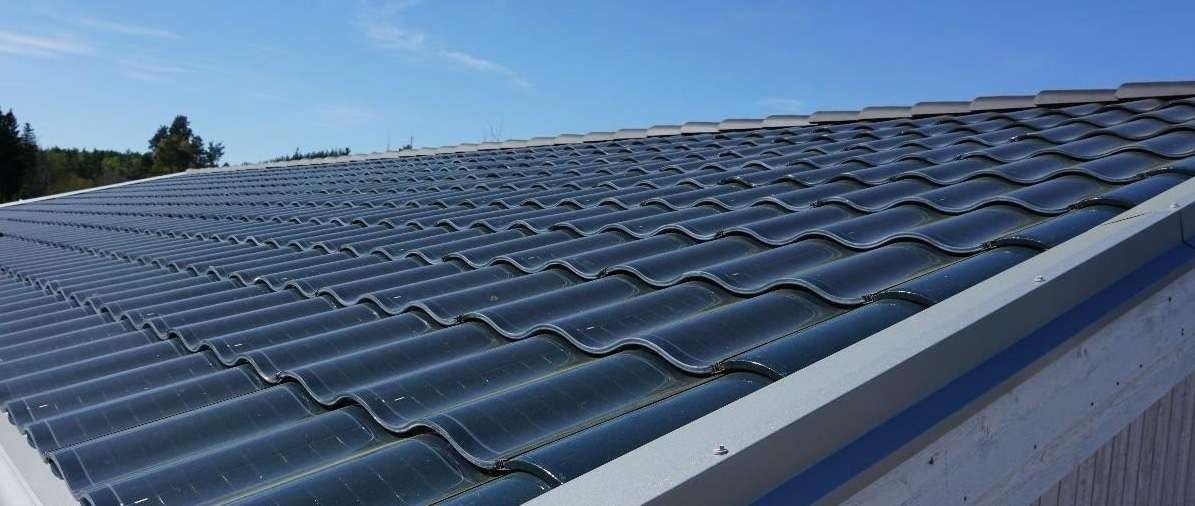
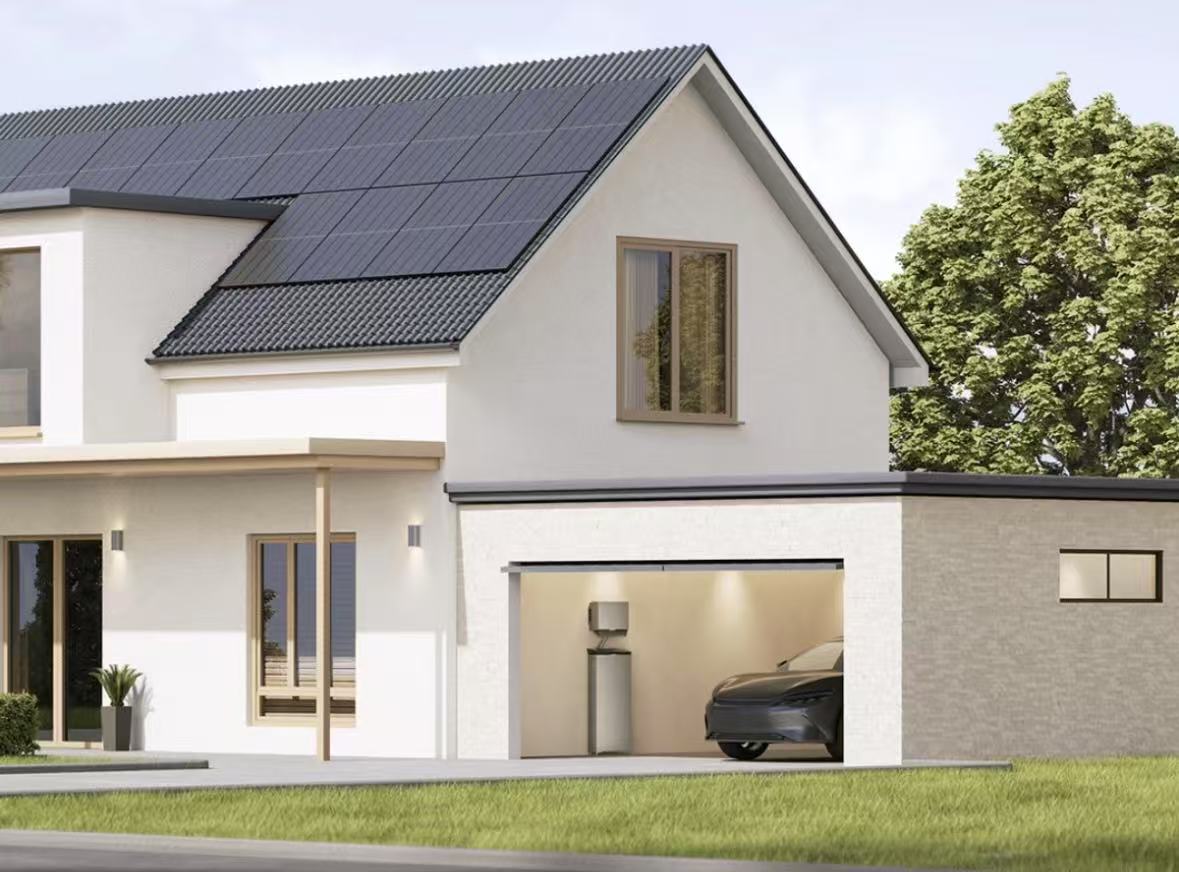
Solar roof tiles, also known as solar shingles, are advanced photovoltaic modules designed to look and function like traditional roofing materials. Unlike bulky panels, these tiles integrate seamlessly into your roof, offering:

  • Stylish design that blends with modern architecture

  • Durable roofing protection against weather conditions

  • Efficient solar power generation for household energy needs


Benefits of Solar Roof Tiles

1. Stylish Design

Solar roof tiles are engineered to complement your home’s architecture. Whether you prefer a sleek modern look or a traditional style, GreenMore’s solar roof solutions ensure your roof remains visually appealing.

2. Sustainable Power

By converting sunlight into electricity, solar roof tiles reduce reliance on fossil fuels. Pairing them with GreenMore home energy storage systems allows you to store excess energy for use at night or during power outages.

3. Long-Term Savings

Installing solar roof tiles can significantly lower electricity bills. With rising energy costs, homeowners can achieve energy independence and enjoy long-term savings.

4. Durability and Protection

GreenMore’s solar roof tiles are built to withstand harsh weather conditions, offering both roof protection and renewable energy generation.


Solar Roof Tiles vs. Traditional Solar Panels

Feature Solar Roof Tiles Traditional Solar Panels
Design Seamless, stylish integration Mounted, visible panels
Durability Dual function: roof + power Primarily power generation
Installation Integrated into roofing Added on top of roof
Aesthetic Appeal High Moderate

Why Choose GreenMore Solar Roof Tiles?

At GreenMore, we specialize in solar roof tiles, home energy storage systems, and commercial solar solutions. Our products are designed to deliver:

  • High efficiency with advanced photovoltaic technology

  • Seamless integration with your home’s design

  • Reliable performance backed by GreenMore’s expertise

By combining solar roof tiles with GreenMore’s household storage batteries, you can achieve complete energy independence and contribute to a greener future.


Conclusion

Solar roof tiles represent the perfect balance between stylish design and sustainable power. With GreenMore’s innovative solutions, homeowners can enjoy a roof that not only protects but also powers their home.

👉 Ready to transform your home with solar roof tiles? Explore GreenMore’s full range of solar energy systems at gmsolarkit.com.

The difference between energy storage inverter and off-grid inverter

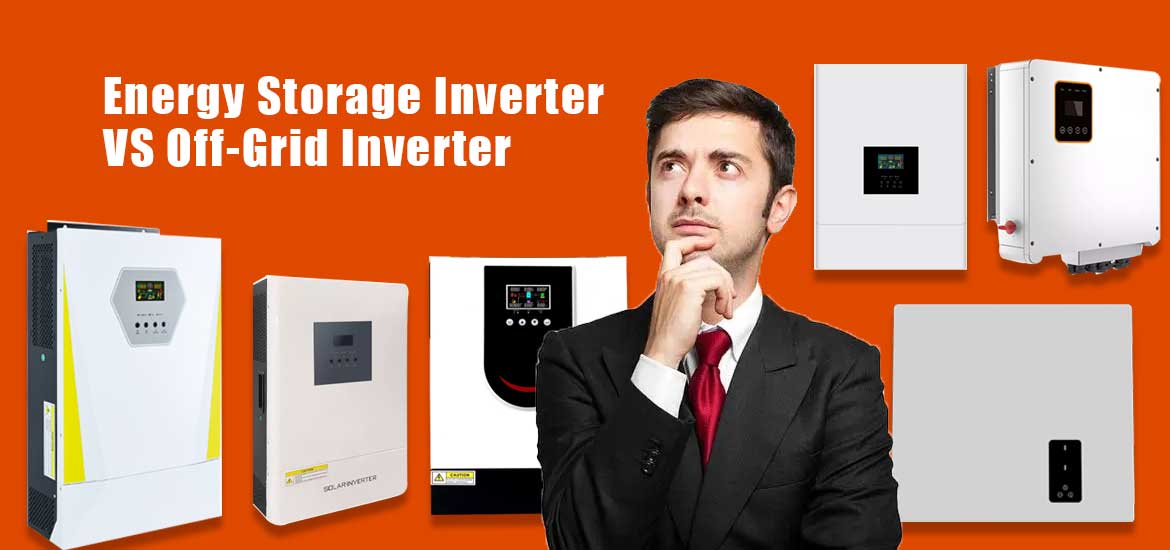
With the rapid development of renewable energy and energy storage technologies, energy storage inverters and off-grid inverters, core components of power conversion, often cause confusion due to their similar functions. As a professional energy storage equipment manufacturer, GreenMore, drawing on over 10 years of industry experience, provides an in-depth analysis of the differences between the two from the perspectives of technical principles, application scenarios, and system design, helping users accurately select the appropriate solution.

1. Technical Principle

An energy storage inverter is essentially a bidirectional DC/AC converter. Its core function is to achieve bidirectional flow of electrical energy:

  • Grid-connected mode: Converts direct current (DC) power from solar and wind power sources into alternating current (AC) and integrates it into the grid. This also supports reverse charging from the grid, enabling peak-shaving and valley-filling energy scheduling. For example, GreenMore's commercial and industrial energy storage system uses energy storage inverters to charge during low-price periods and discharge during peak periods, reducing corporate electricity costs.
  • Off-grid mode: Automatically switches to standalone power supply mode in the event of a grid failure, providing stable power to critical loads. GreenMore's outdoor liquid-cooled energy storage cabinets utilize this technology to ensure continuous power supply in data centers, hospitals, and other scenarios.
  • Intelligent Control: Integrating a BMS (Battery Management System) and EMS (Energy Management System) to monitor battery status, grid frequency, and load demand in real time, dynamically adjusting charging and discharging strategies. For example, GreenMore's containerized energy storage battery cabinet uses AI algorithms to optimize battery life, extending cycle times by over 6,000.

An off-grid inverter is a unidirectional DC/AC converter designed for scenarios where there is no grid or the grid is unstable.

  • Independent operation: Completely disconnected from the public grid, a microgrid is constructed using solar panels and energy storage batteries. For example, GreenMore provides home wall-mounted energy storage systems (5KWh/10KWh) to remote villages in Africa, paired with off-grid inverters to provide 24-hour stable power supply.
  • Pure sine wave output: Utilizing high-frequency PWM modulation technology, the output voltage waveform is consistent with the mains supply, making it compatible with inductive loads such as air conditioners and refrigerators. GreenMore's stacked energy storage batteries (15KWh/30KWh) drive the entire village lighting system via an off-grid inverter, with a distortion rate of less than 3%.
  • Modular design: Supports parallel connection of multiple units to expand power and adapt to loads of varying sizes. For example, GreenMore's GM-DP0100 off-grid inverter can output 10kW per phase and supports parallel operation of nine units for a maximum output of 90kW, meeting industrial and commercial emergency power needs.
The difference between energy storage inverter and off-grid inverter
Function Energy storage inverter Off-grid inverter
Grid connection Support grid-connected, off-grid and hybrid modes Only supports off-grid mode
Energy flow Bidirectional (charge and discharge can be switched freely) Mainly one-way (discharge)
System integration Can collaborate intelligently with photovoltaics, batteries, and power grids Usually operates independently and has low integration
Intelligent Support remote monitoring, peak-valley dispatching, and power grid support Simple functions, focusing on basic power supply
Adapt to the scene Urban households, industrial and commercial users, microgrids Areas without power grid, temporary power supply


off grid solar inverter

2. Application Scenarios

Energy storage inverter

  • Home scenario: Suitable for users already connected to the grid who want to reduce electricity costs and increase energy self-sufficiency. GreenMore's home energy storage system uses a storage inverter to achieve a triple power supply of "photovoltaic + energy storage + grid", increasing the proportion of self-use electricity to over 80%.
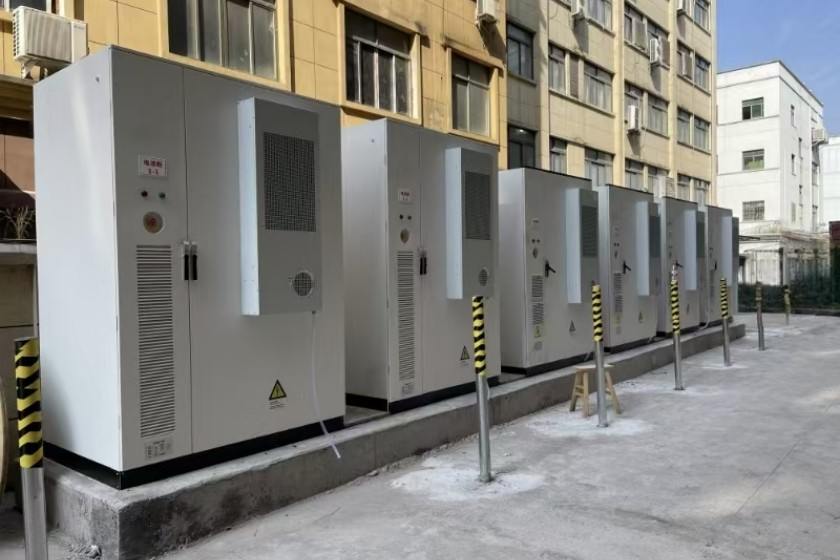
  • Commercial and industrial scenarios: Used for peak-valley arbitrage, demand response, and backup power. For example, a manufacturing company used GreenMore's outdoor air-cooled energy storage cabinet (645kWh) with an energy storage inverter, saving over 500,000 yuan in annual electricity costs while meeting the local grid's frequency regulation needs.
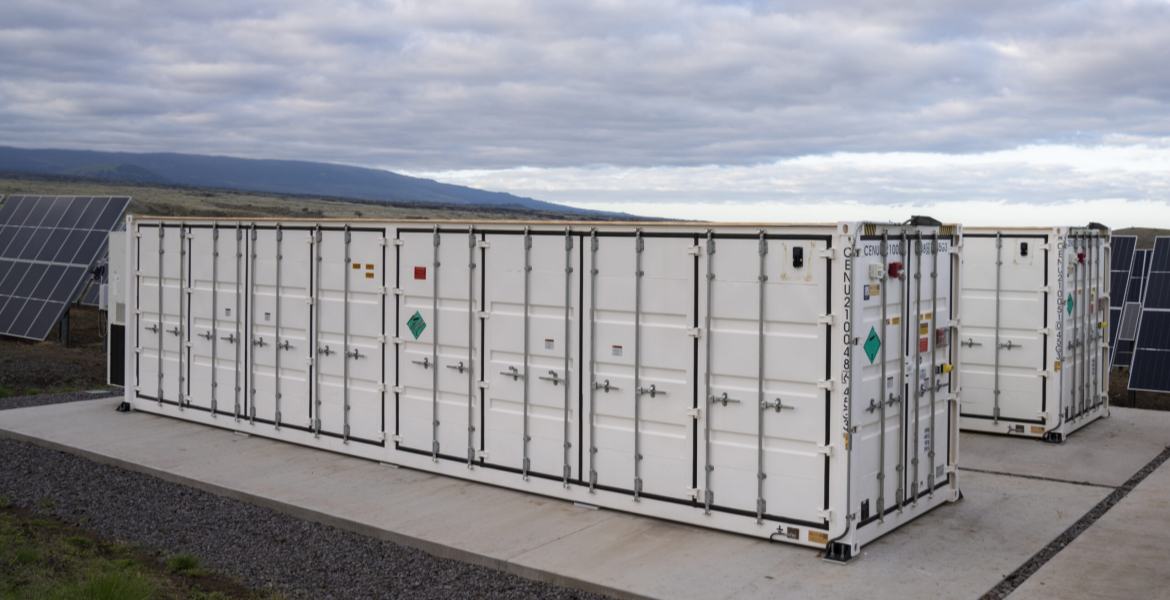
  • Large-scale power plants: As core equipment in solar and wind energy storage systems, they participate in grid peak and frequency regulation. GreenMore's containerized energy storage battery cabinets (2MWh) have been operating stably for over five years in multiple megawatt-scale projects worldwide.

Off-grid inverter

  • Remote Area Power Supply: Providing electricity to off-grid areas such as mountainous areas, islands, and deserts. GreenMore's off-grid energy storage system deployed on Southeast Asian islands replaces diesel generators with solar power and off-grid inverters, reducing carbon emissions by over 200 tons annually.
  • Mobile emergency power supply: Suitable for campers, yachts, temporary construction sites, and other scenarios. GreenMore's portable energy storage battery (5KWh) paired with an off-grid inverter can simultaneously power devices such as rice cookers and projectors.
  • Critical Load Protection: Providing uninterruptible power supply (UPS) for hospitals, data centers, and other applications. GreenMore's liquid-cooled energy storage cabinets achieve millisecond switching via off-grid inverters, ensuring zero interruption to critical equipment.

3. System Design

Energy storage inverter

  • Protection level: Industrial and commercial applications must withstand harsh outdoor environments and must meet IP65 or higher protection levels. GreenMore's energy storage inverter features a dust- and water-resistant design and can operate stably in temperatures ranging from -30°C to 55°C.
  • Communication protocols: Supports multiple protocols such as Modbus, CAN, and RS485, enabling seamless integration with third-party devices. For example, GreenMore's EMS integrates with the factory energy management system via OPC UA, enabling visualization of energy consumption across the entire plant.
  • Scalability: Supports parallel connection of battery clusters and inverters, allowing flexible capacity expansion up to the MW level. GreenMore's containerized energy storage system features a modular design, with customizable single-cabinet capacities ranging from 215kWh to 3.44MWh.

Off-grid inverter

  • Protection level: Primarily for indoor installation, the protection level is typically IP20. GreenMore's home wall-mounted energy storage system uses a fire-resistant ABS casing and is UL94 V-0 certified.
  • Redundant design: Key components use dual backup, such as GreenMore’s Xantrex XW series inverters equipped with dual CPU control boards, with a failure rate of less than 0.1%.
  • User-Friendliness: Equipped with an LCD display and mobile app, the system provides real-time monitoring of system status. For example, users can remotely adjust charging strategies and optimize energy utilization through the GreenMore app.

4. How to choose? GreenMore’s customized suggestions

  1. For those with grid access who want to reduce costs and increase efficiency: Energy storage inverters are preferred, paired with GreenMore's home/commercial energy storage systems to achieve "self-generation for own use + surplus power access to the grid."
  2. No grid or unstable grid: Choose an off-grid inverter and pair it with GreenMore's wall-mounted/stacked energy storage batteries to build an independent microgrid.
  3. Special needs: GreenMore provides customized services, such as designing anti-condensation energy storage inverters for high-altitude areas and developing corrosion-resistant off-grid systems for offshore platforms.

Conclusion

While energy storage inverters and off-grid inverters are both power conversion devices, their technology approaches and application scenarios are distinct. Leveraging our comprehensive industry chain presence and technological innovation, GreenMore has provided over 500MWh of energy storage solutions to over 20 countries worldwide. Whether it's energy saving for homes, cost reduction for commercial and industrial enterprises, or power supply to remote areas, we can help you achieve energy freedom with our expertise.

Contact GreenMore now for a customized energy storage solution!

Official Website: http://www.gmsolarkit.com

Whatsapp: +8618155260624

Email: export@gmsolarkit.com


The Main Revenue Streams of Utility-Scale Battery Storage in the United States

Utility-scale battery storage has become one of the fastest-growing segments in the U.S. energy market. According to the U.S. Energy Information Administration (EIA), most large-scale battery storage projects in operation today generate revenue primarily through electricity price arbitrage—buying electricity when prices are low and selling it back to the grid when prices are high.

Key Findings from the EIA Survey

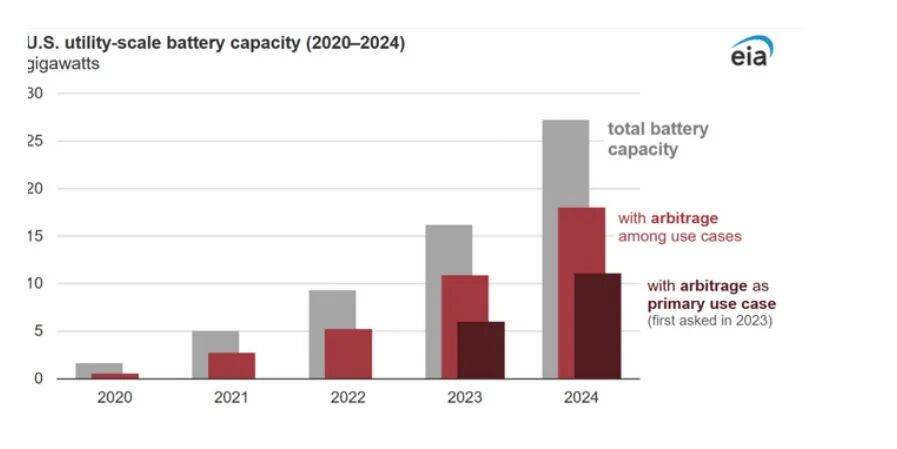
  • In 2024, the U.S. had approximately 27 GW of utility-scale battery storage capacity in operation.
  • Of this, about 18 GW participated in price arbitrage, and 11 GW were dedicated exclusively to arbitrage.
  • This represents a significant increase from 2023, when 16 GW of capacity was online, with 11 GW engaged in arbitrage and 6 GW dedicated solely to it.

The EIA’s annual survey, which collects detailed data from facilities of 1 MW or larger, highlights how the role of battery storage has shifted in recent years. Since 2023, operators have been required to specify the primary use case of their storage systems, providing clearer insights into market trends.

Beyond Arbitrage: Other Revenue Sources

While arbitrage dominates, battery storage systems in the U.S. also provide a range of other valuable services:

  1. Frequency Regulation – 24% of systems are used for stabilizing grid frequency.
  2. Renewable Integration – Balancing wind and solar generation to smooth variability.
  3. Peak Shaving & Load Management – Reducing demand during peak hours.
  4. Co-located Renewable Support – Ensuring stable output from solar and wind farms.
  5. Voltage & Reactive Power Support – Enhancing grid stability and reliability.

Notably, the installed capacity dedicated to arbitrage exceeds that for frequency regulation by about 4.5 GW, and frequency regulation capacity is about 3 GW higher than that used for balancing renewables.

Regional Insights: California and Texas

  • California ISO (CAISO): By the end of 2024, CAISO operated 11.7 GW of battery storage, with 43% primarily used for arbitrage.
  • ERCOT (Texas): Managed 8.1 GW of storage, with half of the capacity focused on arbitrage.

These two markets illustrate how regional dynamics shape storage strategies. In California, low-price charging and high-price discharging strategies have proven effective, while in Texas, ancillary services have historically delivered strong returns.

The Evolution of Arbitrage Strategies

Industry experts note that arbitrage is becoming increasingly complex. As Ali Karimian and Alden Phinney of GridBeyond explained, the rapid deployment of storage has intensified competition, requiring operators to adopt advanced optimization strategies to achieve returns above market benchmarks.

In other words, the future of storage profitability lies not in simple buy-low/sell-high tactics, but in integrated, risk-adjusted solutions that combine arbitrage with ancillary services and renewable integration.

Looking Ahead

The EIA will release updated data for 2025 in June 2026, providing further insights into how storage operators are adapting to evolving market conditions.

As the U.S. energy transition accelerates, utility-scale battery storage is proving indispensable—not only for arbitrage but also for enabling renewable integration, enhancing grid reliability, and supporting decarbonization goals.


Transforming Commercial Buildings with Solar Roof Tiles and Storage Systems

Introduction

For businesses and property developers, energy solutions are no longer just about reducing costs—they are about future-proofing investments and meeting sustainability goals. Solar roof tiles offer a unique opportunity to combine aesthetic design, renewable energy generation, and long-term ROI. At GreenMore, we deliver integrated solutions that empower both households and enterprises to achieve energy independence.


What Are Solar Roof Tiles?

Solar roof tiles, also known as solar shingles, are advanced roofing materials that generate electricity while serving as a protective roof covering. Unlike traditional solar panels, they integrate seamlessly into building design, making them ideal for:

  • Commercial buildings seeking modern, eco-friendly architecture

  • Industrial facilities aiming to reduce carbon footprints

  • Property developers who want to add value and differentiation to new projects


Business Benefits of Solar Roof Tiles

1. ROI and Cost Savings

Solar roof tiles reduce electricity bills and stabilize long-term energy costs. When paired with GreenMore commercial energy storage systems, businesses can store excess energy and avoid peak-time tariffs.

2. Sustainability and Compliance

Governments worldwide are tightening carbon regulations. Installing solar roof tiles helps businesses meet ESG goals, comply with green building standards, and enhance corporate reputation.

3. Energy Independence

With GreenMore’s integrated solar + storage solutions, companies can reduce reliance on unstable grids, ensuring uninterrupted operations during outages.

4. Property Value Enhancement

For developers, solar roof tiles increase property value and market appeal. Buyers and tenants increasingly prefer buildings with renewable energy infrastructure.


Solar Roof Tiles vs. Traditional Solar Panels for Businesses

Feature Solar Roof Tiles Traditional Solar Panels
Design Integration Seamless, modern roofing Mounted, visible panels
Corporate Image Premium, eco-friendly branding Functional but less aesthetic
Energy Efficiency Comparable to panels High efficiency
Value Creation Adds property value Primarily cost savings

Why GreenMore Is the Right Partner

GreenMore offers end-to-end energy solutions:

  • Solar roof tiles for stylish, sustainable power generation

  • Commercial & industrial storage systems for reliable backup and peak shaving

  • Rooftop solar systems for scalable energy production

  • Integrated solar kits tailored to business needs

Our expertise ensures that every project delivers maximum ROI, long-term reliability, and sustainability compliance.


Conclusion

Solar roof tiles are more than just a design upgrade—they are a strategic investment for businesses aiming to cut costs, meet sustainability targets, and enhance property value. With GreenMore’s innovative solutions, companies can achieve energy independence while building a greener future.

👉 Learn more about how GreenMore solar solutions can transform your business at gmsolarkit.com.

What is a Battery Energy Storage System (BESS)?

As renewable energy continues to grow worldwide, Battery Energy Storage Systems (BESS) are becoming the backbone of modern energy management. They enable households, businesses, and utilities to store electricity and use it when needed, ensuring efficiency, stability, and independence.

As a professional manufacturer of battery energy storage products, GreenMore provides innovative solutions for both residential and commercial & industrial (C&I) applications. In this article, we’ll explore what a BESS is, how it works, its advantages, and its applications.

1. What is a Battery Energy Storage System?

A Battery Energy Storage System is a device that stores electrical energy in batteries and releases it when required. Its main functions include:

  • Storing excess energy from solar panels or the grid during off-peak hours.
  • Releasing stored energy during peak demand, at night, or during power outages.
  • Balancing supply and demand to improve energy efficiency and reliability.

2. How Does a BESS Work?

  1. Charging: Electricity from solar panels or the grid is stored in the battery.
  2. Discharging: When needed, the battery releases energy through an inverter, converting DC into AC for household or business use.
  3. Smart Management: A Battery Management System (BMS) monitors voltage, temperature, and capacity to ensure safety and efficiency.

3. Key Benefits of Battery Energy Storage Systems

  • Lower Energy Costs: Store cheap electricity and use it during expensive peak hours.
  • Energy Independence: Combine with solar systems to reduce reliance on the grid.
  • Backup Power: Provide reliable electricity during outages or unstable grid conditions.
  • Sustainability: Support the global transition to clean and renewable energy.

Battery Energy Storage System

4. Applications of Battery Energy Storage

  • Residential Storage:

GreenMore offers wall-mounted batteries, stackable batteries, and all-in-one storage systems with capacities of 5kWh, 10kWh, 15kWh, 20kWh, and customized options. Perfect for households with solar systems.

  • Commercial & Industrial Storage:

Businesses can use BESS for peak shaving, demand management, and energy cost reduction.

  • Microgrids & Off-Grid Solutions:

In remote areas or unstable grids, BESS combined with solar or wind power creates reliable, independent energy systems.

5. GreenMore’s Energy Storage Solutions

At GreenMore, we specialize in:

  • Residential Energy Storage Systems – flexible, safe, and efficient.
  • Commercial & Industrial Energy Storage Systems – scalable and cost-effective.
  • Customized Solutions – tailored to meet the needs of global distributors, resellers, and solar system integrators.

Conclusion

Battery Energy Storage Systems are not just a technology—they are the foundation of the future energy landscape. With GreenMore’s advanced storage solutions, households and businesses worldwide can achieve energy independence, cost savings, and sustainability.

👉 Learn more about our products and solutions on the GreenMore official website.


What preparations should be made before installing an industrial and commercial energy storage system?

As the world's pursuit of sustainable development grows, more and more companies are beginning to consider installing industrial and commercial energy storage systems to achieve the dual goals of energy conservation and emission reduction and economic benefits. As a professional manufacturer of battery energy storage products, GreenMore is committed to providing efficient and reliable energy storage solutions to customers around the world. This article will discuss in detail how companies should make detailed preparations before installing industrial and commercial energy storage systems to help companies take a solid step towards a green future.

1. Understand the electricity price

The first step for enterprises to install industrial and commercial energy storage systems is to have a deep understanding of their own electricity prices. The information on the electricity bill is crucial to evaluating the economic feasibility of the energy storage system. Not only is it necessary to clarify the electricity price system (single system or two-part system), but also to carefully analyze the various expenses in the electricity bill structure, including basic electricity charges, power regulation charges, etc. Especially the local time-of-use electricity price policy, especially the peak-valley electricity price difference. If the price difference is significant (it is recommended to reach more than 0.8 yuan/kWh), the economic advantage of installing an energy storage system is particularly prominent. By charging during the valley period when electricity prices are lower and discharging during the peak period when electricity prices are higher, the electricity cost can be effectively reduced.

2. Evaluate electricity demand

After understanding the electricity price, the next step is to conduct a comprehensive assessment of your own electricity demand. This not only involves the total electricity consumption of the enterprise, but also should be combined with historical data to predict future trends. This information helps to scientifically configure the energy storage system. In addition, special attention should be paid to the electricity load period on the electricity bill, especially the proportion of electricity consumption during peak hours, which is crucial to the potential of the energy storage system in reducing peak loads and filling valleys and reducing costs. Reasonable arrangement of the charging and discharging time of the energy storage system can further reduce electricity bills.


container battery energy storage system


3. Inspect the transformer capacity

Before installing an industrial and commercial energy storage system, the capacity of the transformer must be investigated. The available capacity of the existing transformer must be accurately calculated, and the future load growth trend must be considered. Ensure that the operation of the energy storage equipment does not affect the stability of the power grid. Especially when charging during off-peak hours, the transformer capacity allocation must be reasonably planned to avoid overload operation, ensure the normal operation of the energy storage system and the safety and stability of the power grid.

In summary, installing an industrial and commercial energy storage system is a complex but valuable process. Through in-depth understanding of electricity prices, assessing electricity demand, examining transformer capacity and other preliminary preparations, companies can configure energy storage systems more scientifically, thereby achieving energy conservation and consumption reduction and improving economic benefits. GreenMore is willing to work with you to help your company move towards a greener and more efficient future.


The Guarded Solar Panel How Bird Netting Protects More Than Just Panels—It Protects Your ROI

The Guarded Solar Panel: How Bird Netting Protects More Than Just Panels—It Protects Your ROI


In the pursuit of optimal solar panel performance, we often focus on pv framed panel grade and inverter efficiency. However, a pervasive, everyday threat can undermine even the best-engineered systems: birds. This article moves beyond anecdote, using published research and engineering principles to analyze why bird protection is a critical component of solar support system design and how aluminum rack netting provides the optimal solution.


The Tangible Cost of Bird Contamination:
Research demonstrates that bird droppings are a severe form of soiling. One 2025 study found that contaminated panels saw efficiency drop to about 15%, compared to 20% for clean, cooled solar modules. The solar panel power output of soiled pv panel modules decreased by 12-33%.
The damage is more than surface-level. Droppings create localized shading, leading to dangerous "hot spots" that increase solar cell temperature and accelerate long-term degradation and potential failure. The acidic nature of the droppings can also corrode solar panel frames and backing sheets.

Why Solar Aluminum Netting is the Superior Choice:
While various deterrents exist,professional-grade aluminum netting is considered a well-proven, long-term exclusion method. Here's how it compares:


Durability & Longevity: Aluminum naturally resists corrosion. It withstands harsh tropical sun, rain, and salt air far better than plastic or uncoated steel nets, which can become brittle or rust.

Solar Structural Integrity: It maintains its shape and tension over time, ensuring a consistent barrier without sagging.

Non-Conductive & Safe: Unlike steel, aluminum does not pose a conductivity risk if it comes into contact with electrical solar components.

Lightweight & Solar Install-Friendly: It's easier to handle and install correctly without putting undue stress on the solar mounting structure.

Conclusion: An Investment, Not a Cost
Installing a high-quality aluminum bird netting system upfront is a strategic investment. It safeguards energy yield, reduces risky and frequent cleaning cycles, and protects the physical asset from corrosive damage. For project developers, EPCs, and asset managers, it translates to higher lifetime energy production, lower O&M costs, and preserved asset value—cornerstones of a strong financial return.


Contact info@hqmount.com to get a professional solar related products recommendation and a price for solar bird netting.


Why Ballasted Mounting Poses a PV Structural Risk on Solar Concrete Roofs

Why Ballasted Mounting Poses a PV Structural Risk on Solar Concrete Roofs

Title:The Unseen Danger: Why Ballasted Solar Mounting Fails on Concrete Roofs

Introduction
In the solar industry, the appeal of a ballasted mounting system—requiring no roof penetrations—is clear. It promises simpler installation and preserved roof integrity. Consequently, it is frequently, and often mistakenly, considered for large concrete roofs on commercial and industrial buildings. However, applying this ground-mounted logic to an elevated concrete rooftop ignores critical structural and aerodynamic principles. What seems like a prudent choice can initiate a chain of risks that compromise safety and system longevity. This article explains the three fundamental engineering reasons why ballasted systems are a high-risk proposal for concrete roofs and identifies the correct, safer alternative.


1. The Amplified Wind Load Effect
On open ground, wind can flow freely under and around a ballasted array, reducing pressure. A concrete roof, however, is typically bounded by parapet walls, creating a partially enclosed space. When wind hits this solar structure, the parapets obstruct and redirect airflow, causing it to become trapped and turbulent between the roof surface and the solar array. This phenomenon significantly amplifies upward lift forces (uplift pressure) compared to standard calculations for open terrain. The ballast blocks, instead of merely holding down the pv structure, must now resist these abnormally high and dynamic forces. Relying on standard solar ballast calculations in this environment is a dangerous underestimation.

2. The Vicious Cycle of Dead Load
The first problem directly creates the second: to counteract the increased wind uplift, more ballast weight is required. This initiates a vicious cycle. Each additional kilogram of concrete or steel ballast adds permanent dead load to the roof structure. Many buildings have limited design load margins. This escalating weight can approach or exceed the roof's safe load-bearing capacity, posing a potential collapse hazard. The supposed benefit of "non-penetration" is completely negated by the introduction of excessive, unsustainable weight, potentially necessitating expensive structural reinforcement that defeats the system's cost-saving premise.

3. Long-Term Point Load Failure and Concrete Creep
Even if the roof's overall capacity appears sufficient initially, ballasted systems impose dangerous point loads. The immense weight is concentrated at the small feet of each mounting post. Concrete, under sustained heavy loads, is subject to creep—a slow, permanent deformation over time. Coupled with decades of wind-induced vibration and stress cycles, these concentrated points are prone to cracking, spalling, or sinking. This progressive failure can destabilize the entire array, leading to misalignment, glass breakage, or worse. This slow, photovoltaic structural degradation often manifests years after solar rooftop installation, making it a latent and costly liability.


The Engineered Solution: Professional Mechanical Attachment
For concrete roofs, the only safe and durable solution is a professionally engineered, mechanically fastened system. This involves:

Structural Load Analysis: A certified engineer verifies the roof's live and dead load capacity.

Proper Anchoring: Using engineered roof penetrations with chemical anchors or mechanical bolts designed to transfer structural loads directly into the building's support structure.

Waterproof Integrity: Employing proven, long-term weather-sealing techniques (like compression gaskets and sealants) at every penetration point.

This method eliminates the wind amplification risk, adds minimal dead load, and avoids destructive point loads, ensuring a secure installation with a lifespan matching the solar panels.

This article clarifies the specific wind condition threshold that determines the viability of ballasted systems and exposes the risks of exceeding it.


Understanding the Wind Speed Threshold: 35 m/s
A crucial distinction must be made: ballasted systems are not inherently flawed; they are context-dependent. For low-wind zones (typically below 35 m/s) and on ground-mounted systems or roofs with exceptional load capacity, a properly engineered ballasted solution can be safe and effective. At these lower wind speeds, the required ballast weight remains within reasonable limits, and the risk of wind amplification is minimized.

The danger arises when this solution is applied to high-wind regions (where design wind speeds approach or exceed 35 m/s) on confined concrete roofs. Here, the triple threat of wind amplification, exponential ballast increase, and point load stress converge, making the system economically and structurally unsound.


A Word of Caution on Performance Claims
In this context, be wary of solar mounting manufacturers promoting ballasted systems with exceptionally high wind resistance ratings (e.g., 50 m/s or more) for concrete roof applications. While the brackets themselves might be rated for such winds, achieving this on a roof requires an immense, often impractical amount of ballast to counteract the amplified uplift. More critically, this calculated ballast weight frequently exceeds the safe dead load capacity of a standard concrete roof. Such proposals may rely on idealistic, non-enclosed test conditions and overlook the paramount constraint: the roof's structural integrity. Always insist on a site-specific structural load analysis from a qualified engineer.


Conclusion
The 25+ year lifespan of a solar asset demands a solar foundation that is unequivocally safe. On concrete roofs, choosing a ballasted system introduces a complex web of aerodynamic and structural risks that can jeopardize the entire investment. True professionalism in solar deployment means selecting the right tool for the environment. By partnering with experienced engineers and opting for a mechanically attached system designed for the specific roof, developers and installers ensure not only the performance but also the fundamental safety and integrity of their solar investment.


Contact us at info@hqmount.com for a solar roof top design from hqmount the leading solar mounting manufactuerer in China.
 

The Complete Racking System Your Unseen Advantage in Southeast Asia's Solar Market

The Complete Racking System: Your Unseen Advantage in Southeast Asia's Solar Market


For solar installers and solar EPCs in Thailand and Indonesia, success is built on efficiency and reliability. While much attention is given to panel efficiency, the true unsung hero determining a solar power project's speed, cost, and long-term performance is the pv racking system. A common pitfall in booming markets is sourcing pv components piecemeal—solar roof hooks from one supplier, pv aluminum profiles from another, solar panel mid and end clamps from a third. This approach introduces hidden costs and risks.

The solution is a complete, engineered racking ecosystem. By choosing a single-source provider for every component—from the solar panel roof hook to the pv grounding washer—you secure a decisive advantage in the competitive Southeast Asian solar landscape.


Part 1: The Hidden Cost of a "Mix-and-Match" Approach
Sourcing individual solar mounting components based solely on price might seem economical, but it creates downstream challenges critical to markets like Thailand and Indonesia:

  • Compatibility Gaps: A tile roof hook from Factory A might not align perfectly with a solar pv profile from Supplier B, requiring on-site modifications that delay solar roof projects.

  • Quality Inconsistency: Differing material grades or manufacturing tolerances between solar system parts can create weak points, compromising the system's wind and load resistance.

  • Logistical Overhead: Managing multiple suppliers, warranties, and shipping schedules complicates project management unnecessarily.

Part 2: Decoding the Complete Solar System: A Component-by-Component Advantage
Our comprehensive lineup is engineered as one interdependent solar pv system. Here’s what that integration means for your project:

  • Solar Roof Interface & Adaptability (Roman Tile Hooks, Flat Tile Hooks, L-Feet): Designed specifically for common roofing materials across Southeast Asia, these components ensure a secure, weatherproof, and non-damaging attachment. Adjustable legs allow for perfect leveling on uneven roofs, a common site challenge.

  • The solar Structural Backbone (Aluminum Profiles, Standing seam Clamps): The rails form the primary structure. Our profiles and their connection hardware are tested together for optimal strength and corrosion resistance, crucial for coastal and high-humidity environments.

  • Panel Security & Integration (Mid Clamps, End Clamps): These solar panel clamps are precision-matched to our pv profile geometry, ensuring the correct torque and holding force is applied without damaging panels, guaranteeing long-term security.

  • Safety & Professional Finish (Grounding Lugs, Cable Clips, Grounding Washers): A safe, code-compliant, and tidy installation is non-negotiable. Our integrated grounding components and management accessories ensure a professional result that passes inspection and lasts.

Part 3: The Tangible Benefits for Your Business
Choosing this complete ecosystem translates directly to your bottom line and reputation:

  1. Reduced Solar Installation Time: Pre-verified compatibility means installers work faster, with less troubleshooting. You can complete more solar power projects.

  2. Enhanced System Reliability: Uniform quality and engineered compatibility minimize the risk of premature failure, protecting your clients' assets and your company's reputation.

  3. Simplified Solar Project Management: One order, one shipment, one technical contact, and one warranty for the entire mounting system. This streamlines operations significantly.

  4. Stronger Client Trust: Delivering a clean, robust, and trouble-free installation builds customer satisfaction and leads to referrals.

Conclusion: Build Faster, Build Smarter
In the dynamic solar markets of Thailand and Indonesia, where project timelines are tight and quality expectations are high, the pv racking system should be a source of confidence, not complexity.

By partnering with a supplier that provides a fully integrated racking ecosystem, you're not just buying components—you're investing in a smoother workflow, a more reliable installation, and a stronger business foundation.

Ready to streamline your next power project? Contact us at info@hqmount.com to learn more about our complete solar roof racking solutions tailored for the Southeast Asian market.